
The Second Name | Singularity Repeated
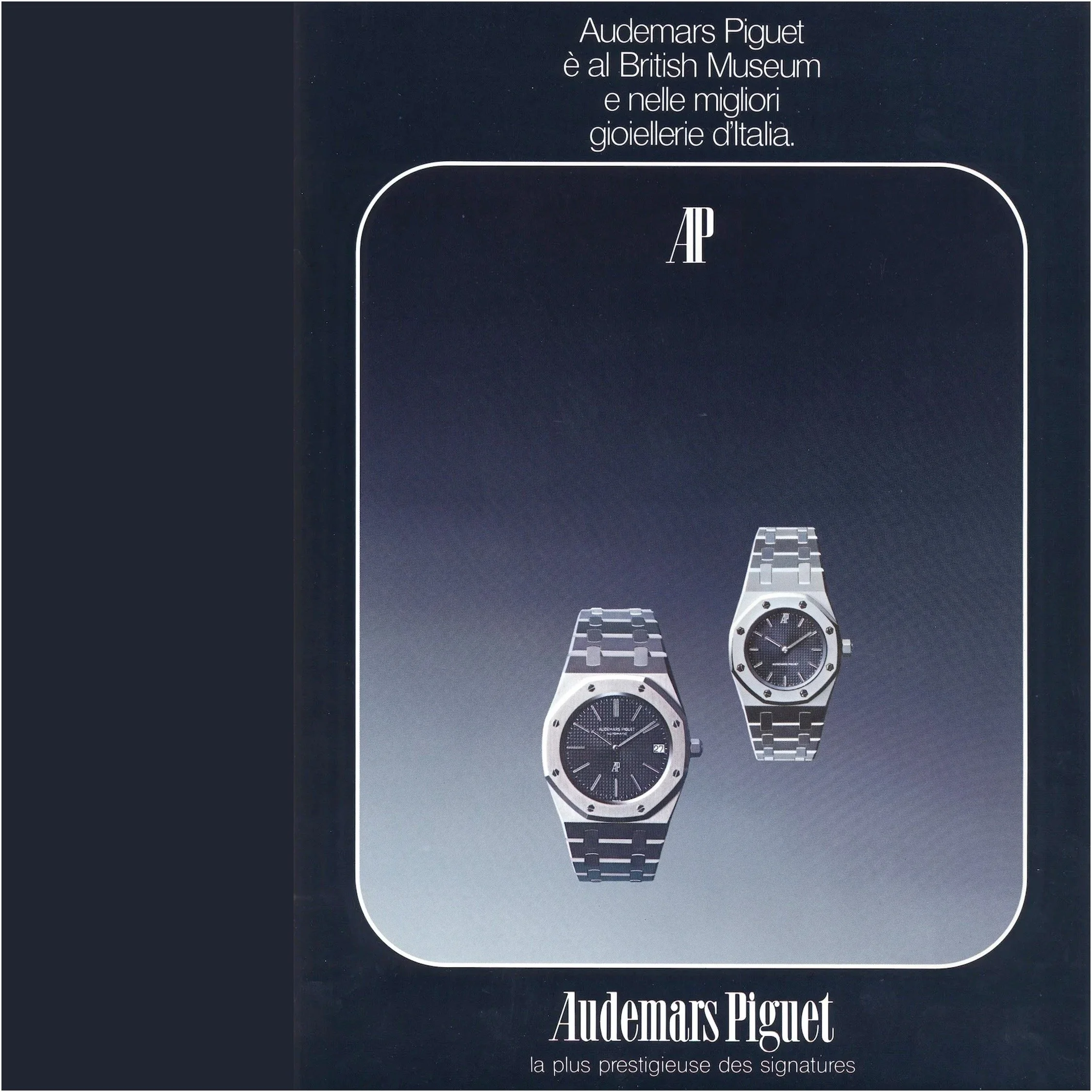
Audemars Piguet Royal Oak II 8638ST
In the Shadow of an Icon, the Royal Oak II has long existed as a misunderstood outlier—its significance obscured, its role within the early Royal Oak narrative rarely examined.
Even its name invites simplification. ‘Royal Oak II’ suggests sequence—a successor to the original Royal Oak 5402—yet in practice it represented something less defined. It was neither strictly positioned by gender nor confined to a single interpretation, and within that ambiguity, it remained obscured.
Seemingly modest by today’s standards, approximately 500 watches sold in its first year placed the Royal Oak II near parity with the launch of the Royal Oak itself. It introduced material diversity and, more importantly, validated the Royal Oak as a platform rather than a static design. By 1978 through 1980, Royal Oak II sales across materials exceeded that of the Royal Oak 5402 during their final years of overlap.
This challenges a persistent assumption. The Royal Oak is often framed as a singular expression of Gérald Genta’s original vision—fixed, defined, and complete. Royal Oak II suggests otherwise: Royal Oak had already begun evolving beyond a single reference into something more expansive. In this sense, it was not a deviation, but a proof of concept.
With hindsight, it is easy to view these variations as peripheral. AP’s published data suggests otherwise. They were not only present—they were competitive, and at times dominant, within the Royal Oak family itself. That this remains largely unrecognized today—even within discussions surrounding Audemars Piguet—only reinforces how the Royal Oak II has been historically misunderstood.
-
Gérald Genta designed one Royal Oak—geometric, architectural, unapologetically industrial in steel. In 1972, Audemars Piguet introduced something it had never done before: it gave a watch a name.
Royal Oak. Singular.
Not conceived with adaptation—let alone reinterpretation. It would take four years to produce the first thousand.
In 1976, the context changed.
With quiet confidence, Audemars Piguet debuted the Royal Oak II within the sanctum of high jewelry, Fred Paris.
Surrounded by the soft shimmer of Place Vendôme’s traditions, where light bends itself around gold and diamonds,
something else takes its place.A steel sports watch.
No diamonds to catch the eye. No concession to expectation.
Powered by an automatic movement, in a moment turning to quartz.
If the Royal Oak was disruptive, Royal Oak II shifted the conversation.
The object did not change. The context did.
High watchmaking is reframed as a discipline more precious than material— by the hand.
A Royal Oak can be recognized by its components,
but more exceptionally, by its surface—
where steel is finished like gold, reflecting light like diamonds.Royal Oak II did not announce itself as a departure.
It allowed its surroundings to reveal that it already was. -
That shift—from confidence as belief to confidence as the absence of doubt— is the quiet architecture.
Most narratives about design depend on explanation.
They justify why something works, why it matters, why it was necessary.This is confidence as belief—
persuasive, outward-facing, dependent on recognition.But the Royal Oak II operates differently. It does not argue for itself.
It does not adapt to expectation.
It does not resolve tension.What began is a projection into the unknown, became a redefinition of the possible..
Royal Oak II did something few objects ever achieve. It did not ask what was wanted;
it showed what was possible—
and required nothing further.The material is not justified.
The audience is not defined.
Its position within the Royal Oak lineage is deliberately unresolved.Confidence, here, is expressed through omission— through what is not clarified,
through what is not reinforced.It is the discipline of presenting an idea fully formed— and resisting the instinct to explain it further.
In this sense, Royal Oak II is not simply a continuation of the Royal Oak. It is a test of it.
The first established an identity.
The second asked—quietly, precisely—
whether that identity could stand without reinforcement.It could. And it did.
-
Designed for women, by a woman.
Its language is expressed with new intent.The Royal Oak II is entrusted to Jacqueline Dimier—
a contemporary of Genta, and among the earliest in-house designers at Audemars Piguet.She represents custodial continuity rather than singular origin. Not succession by replacement,
but succession as stewardship.She begins with the Royal Oak as it is— governed by discipline:
angular, assertive, uncompromising.She does not soften it. She does not decorate it.
The geometry remains. The discipline remains.
The resemblance is intentional.
Nothing is changed.
The decision is exact—
held in the hand that carries it forward.By preserving the integrity of the design,
she removes the assumption that it belongs to a single wearer.It is not adapted.
It is extended—through trust.No precedent justified it.
The category did not exist—before it did.It does not become feminine through alteration— but through intent.
-
A name, once given—
is not meant to be used again.In 1972, Audemars Piguet did something it had never done before. It named a watch—
Royal Oak.
Not a reference. Not a variation. A name.
It marked a singular moment—
an object complete enough to stand apart from everything around it.And then, four years later, it named it—again. Royal Oak II
A second act of naming.By then, the name Royal Oak had already begun to shift.
What was conceived as a singular object was becoming something else— a system, a language, a collection.A name that once pointed to one thing was beginning to contain many.
If the first name established identity, the second tests its limits.
Not in theory— but in use.
In context.
In repetition.Royal Oak II is quieter.
And in that quiet, something becomes clear: a collection expands through adaptation, but a name, when used precisely, resists it.
Over time, the Royal Oak becomes what it was never meant to be— not a single object, but a field of possibilities.
Dial, size, material, complication—
each variation both faithful and divergent.The name stretches.
It no longer points with the same precision.And so the second name begins to dissolve.
Not physically—the watches remain. Not historically—the records are intact. But conceptually.
Because within a collection,
there is no need for a second singularity.Royal Oak II exists in this tension— inside the Royal Oak, and outside it.
Part of the lineage,
yet not fully absorbed by it.It exposes a quiet truth:
the Royal Oak was not conceived as a collection, but as a complete idea.And that idea, once tested, did not need to change.
So the question remains:
If the first name became a world,
and that world expanded beyond its origin— what does the second name preserve?Not difference. Not evolution.
But something far more fragile:
The possibility that the original idea was already complete.